How I helped Philomena track down her son sold by cruel nuns: It’s the film about a toddler torn from his mother that is reducing grown men to tears… but the REAL story will haunt you forever
- Philomena Lee fell pregnant as a teenager and was sent to a convent
- Her son was taken from her by the nuns and adopted by a US family
- Journalist Martin Sixsmith helped her track him down fifty years later
By MARTIN SIXSMITH 9 November 2013

Her story: Philomena Lee’s search for her son became the subject of journalist Martin Sixsmith’s book.
I first heard of Philomena Lee at a New Year’s party in 2004, when her daughter Jane approached me to ask for help. She told me her mother had just revealed a shocking secret – that she, Jane, had a long-lost brother. Could I, a former journalist, find out more?
Philomena had fallen pregnant as a teenager in Ireland in 1952 when such things were considered shameful and had been sent to Sean Ross Abbey, a convent in Roscrea, County Tipperary, to give birth as a ‘fallen woman’.
She was forced to spend three years in the convent, slaving in the laundries while also caring for her son, Anthony. The story became more disturbing still when, a short while later, I met Philomena herself for the first time and she explained that her child had been taken from her to be adopted in America – in return for a hefty ‘donation’ from his new parents.
Philomena had spent the past 50 years searching for him while Anthony, as I later discovered, was also searching for her. Separately, and ignorant of each other’s quest, they had both visited Sean Ross Abbey.
Yet, in perhaps the most heartless betrayal of all, the nuns who could have helped them find each other failed to respond to their pleas for assistance.
Mother and son had contacted the Abbey within a short time of each other, so Sister Hildegarde – who oversaw all the forced adoptions – knew they were each looking for the other.
She knew that Philomena’s brother and sisters, Anthony’s uncle and aunts, lived just a short drive away. But she did not tell him.
Intrigued and appalled by what I had heard, I started my own investigation. It took a lot of patient detective work – not helped by an obstructive Catholic Church – to discover what had become of Philomena’s son.
My search took me to Ireland, to America and eventually to the White House itself. It lasted nearly four years and it became the subject of my book, Philomena.
This, in turn, has inspired a poignant film starring Dame Judi Dench and Steve Coogan. Such is the emotional force of her story that it has already become one of the year’s most unlikely box office hits.
I soon discovered that Philomena and Anthony were not alone in their ordeal. The Catholic Church-run adoption trade started in the years after the Second World War, when American servicemen at the end of their European tour of duty began to take adopted Irish babies home with them.

The lost boy: Philomena’s son Anthony as a young child at the Sean Ross Abbey, a convent in Roscrea, County Tipperary, where he spent his first years
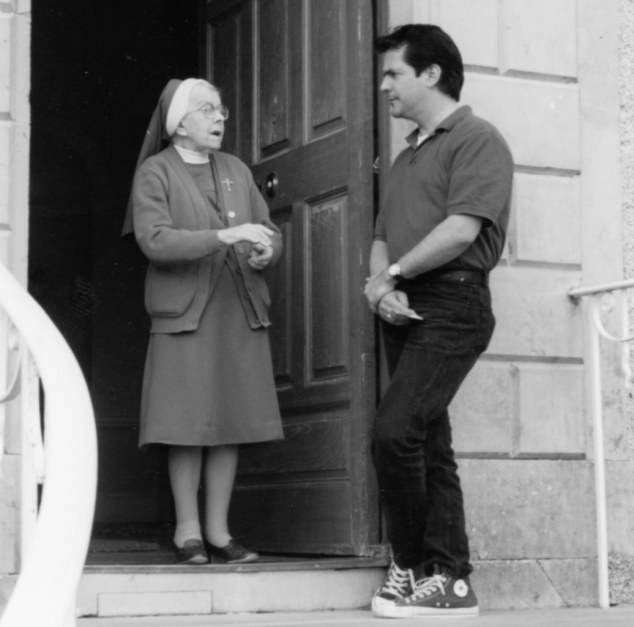
Lost boy: Anthony – renamed Michael – returned to the convent in 1993 and met with Sister Hildegarde – who mentioned nothing about his mother Philomena – or that his siblings lived just a short drive away
There was no paperwork and no exact record of how many children were involved, but a report in the Irish Times declared that ‘500 babies were flown from Shannon for adoption’ in 1950, adding that ‘that number is believed to have been exceeded in the first nine months of 1951 alone’. In October of that year, 18 groups of children left Shannon in a single week. The numbers were undoubtedly huge and the sketchy official statistics, which guess at 2,000 children exported to America in the years after 1953, grossly underestimate the true total.
I discovered there were numerous convents involved, not just Roscrea.
St Patrick’s Mother and Baby Home in Dublin, Bessborough Convent in Cork, St Peter’s in Castlepollard, Co Westmeath, and St Clare’s Baby Home in Stamullen, Co Meath, all continued to send regular parties of so-called orphans to the US for almost two decades. And no wonder – the trade was a lucrative one.
The going rate for American couples wishing to adopt was between £500 and £1,500, a great deal of money in the 1950s. The Hollywood film star and glamour girl Jane Russell was among those who paid up. In late 1951 she travelled to Ireland with the intention of adopting a child.
Speaking to reporters, she had made no bones about it: ‘I hoped I would be able to find a boy in England but it seemed to be impossible…the British law will not allow me to take a child abroad, so I have been advised to try Ireland…I intend to fly to Dublin this week to pick out a child and make all the arrangements for bringing him to America’.
She eventually adopted a little boy from Galway called Tommy Kavanagh, and this real-life story was the inspiration for the episode in the film where Steve Coogan – playing me – finds an incongruous photograph of the scantily-clad film star on the wall of the nuns’ parlour.
There were critics at the time. One newspaper spoke out, in an article headlined, ‘1,000 children disappear from Ireland’ and saying: ‘Ireland has today become a sort of hunting ground for foreign millionaires who believe they can acquire children to suit their whims in just the same way as they would get valuable pedigree animals. In the last few months hundreds of children have left Ireland, without any official organisation making any enquiries as to their future habitat.’
These concerns, however, seemed to make little difference in a post-war Ireland still powerfully under the sway of the Catholic Church. The Church insisted unbendingly that adopting couples should be practising Catholics, but there was no proper investigation of their background – as long as they had the money to pay the ‘donation’.
The result was that the ‘orphans’ were sold to the highest bidder, however unsuitable they might be.
There were stories of children being ill-treated and abused in their new homes, but the Irish government did little to curb the exodus.
It was the Church that wielded the greater authority – and who clamped down on adverse publicity, ordering a news blackout.
When rumours of the Church’s role began to emerge decades later, much of the incriminating paperwork was destroyed.

Convent life: Children born to unwed mothers sit in the Sean Ross Abbey dining hall under the watch of a nun
Sister Hildegarde herself admitted to a social worker shortly before her death that she had destroyed documents relating to the payments received from US couples adopting Irish children. Such payments, she said, were the convent’s largest source of revenue in the 1950s.
Even today, the Church guards its adoption archives fiercely. It took a painstaking trawl through passport records and the piecing together of references in old newspapers before I discovered exactly what had become of Philomena’s son Anthony.
It was a shameful episode, for which there has still been no official apology; and women from the Mother and Baby homes have not been included in the compensation scheme offered to former inmates of the notorious Magdalene Laundries.
Stephen Frears’s film adaptation of my book is beautifully wrought, steering a path between affecting pathos and laugh-out-loud humour. The film – and my book before it – have prompted scores of women with similar stories to come forward to say that they, too, had been deprived of their children.
Philomena was one of thousands of unmarried mothers taken away from their homes and families in the post-war decades because the Catholic church said they were moral degenerates who could not be allowed to keep their children.
Many of the women who have come forward said they, like Philomena, had kept the ‘guilty secret’ of their illegitimate children for decades, not telling families or friends as the Church had told them they would be damned if they did. And many of them echoed Philomena’s story of appealing to the nuns for help in finding their children. Like her, they were rebuffed.
They have not been the only ones to suffer. The children who were taken away for adoption have also spoken up to say that they too had spent their lives wondering and yearning – for the mother they had lost. As with Philomena and her son Anthony, it was clear that parents and children had been simultaneously looking for each other.
So while ‘Philomena’ tells one woman’s story, it is emblematic of the fate of hundreds, perhaps thousands of others. Yet it took Philomena herself a lot of soul-searching and courage before she agreed to let me write my book about her story – despite the injustice and cruelty she was subjected to. The sense of guilt and stigma that had been drummed into her half a century ago was still powerful all those years later.
ANNIE, 90: THEY TOOK MY CHILD AWAY ON HER BIRTHDAY

Precious: Annie Costello’s daughter Theresa on the day that she was adopted in America 1951
Ninety-year-old Annie Costello will not be among those flocking to see Philomena – it will simply be ‘too painful’. For she knows all too well about the cruelty and loss the film depicts.
Annie was 23 when she fell pregnant in County Offaly. There was, she says, ‘no room for a baby born out of mortal sin’.
So in March 1946, a weeping Miss Costello walked alone into the Sean Ross Abbey in Tipperary, placing her life and that of her unborn baby into the hands of the Sisters of the Sacred Heart, just as Philomena Lee would do a few years later.
‘It was a terrible choice to have to make but I was a fallen woman so who else was going to help me?’ she says in an Irish accent that remains thick despite more than 50 years living in Southend-on-Sea, Essex.
As a ‘fallen woman’ Annie was given the house name Olive, and made to toil in the kitchens and in the fields, even while heavily pregnant. ‘We were fed almost nothing, just a cup of tea and a slice of bread and margarine at night,’ she recalls.
When her baby, Theresa, was born on July 12, she weighed only 4lbs and almost died at birth. ‘She was mine for five years,’ Annie adds, her voice filled with years of sorrow. ‘She was such a beautiful little girl and I never forgot her lovely, natural curly hair.’
Then on July 12, 1951 – Theresa’s fifth birthday – the nuns dealt Annie an excruciating blow. She says: ‘Sister Hildegarde, who was head of the nursery, came up to me that morning and told me my baby had gone to another home in America. I was devastated. I never got to say goodbye to my little girl, never got to give her a final kiss before they put her on a plane. How could anyone be so cruel?’
In fact, Theresa had been sold by the nuns to new parents in St Louis, Missouri – just as Philomena’s son Anthony would be four years later.
It was 50 years before Annie would lay eyes on her daughter again.
‘I missed Theresa every day,’ she says. ‘I always wondered how she was and I would have loved to have sent her a birthday card and a Christmas card. There were many nights I would just lie there and cry.’
But after decades of searching, and thanks to a lucky phone call to directory enquiries, she found her. ‘The first time we spoke, we were both sobbing so much down the phone,’ says Annie.
‘Theresa visited me a few months later and when I saw her at the airport for the first time I was terrified. The only thing I knew to do was give her a hug.’
‘It was a terrible thing the nuns did to all of us. But I was lucky – Theresa came back to me.’
‘All my life I couldn’t tell anyone. We were so brow-beaten,’ she told me when we first met. ‘It was such a sin. It was an awful thing to have a baby out of wedlock. Over the years I would say, “I will tell them, I will tell them” but it was so ingrained down deep in my heart that I mustn’t tell anybody that I never did’.
That’s why, when I receive letters from people who have read my book or seen Stephen Frears’s film, I pass them on to Philomena. Reading the words of thanks from other women in her position has vindicated her decision to allow her story to be told.
Some of the letters have been heart-rending. One wrote: ‘I took my aunt to see the film Philomena today – lots of tears, laughter, reflection. At the end she told me she had been in touch with the adoption agency in Ireland about her first-born. I truly believe that now the film and story are out there that maybe her daughter might try to trace her.’
On Irish websites, where information is exchanged between children hoping to find their mothers and mothers looking for their sons and daughters, the film has been welcomed as a potential spur for the authorities to take seriously the growing demands for official archives to be opened.
This is how a contributor to the Adoption Ireland site responded to it: ‘This film could be the catalyst for change but only if everyone uses their voice. Let’s hope it is the start of something.’
But there also was anger at the continuing official secrecy over the baby trade: ‘The Irish government and the church will keep a lid on information about illegal adoption and tracing rights unless more and more people use their voice.
‘Philomena was one person and that’s all you need. Now is the time to be active. The highlight for me was how the nuns were portrayed – as they should be: cruel, judgmental and controlling. This book was written in 2009, only four years ago when the nuns were still denying everything. It’s recent and raw, and information is still being denied.’

On the silver screen: Judi Dench plays Philomena Lee and Steve Coogan takes on the role as journalist Martin Sixsmith in Philomena
Sister Julie Rose, assistant congregational leader of the Sisters of the Sacred Hearts of Jesus and Mary – who ran the convent in Roscrea – criticised the film for being ‘misleading’ and not telling the whole truth. But my book and Stephen Frears’s film tells Philomena’s story. If the nuns are portrayed as the villains of the piece, that’s because that’s exactly what Philomena and others felt them to be.
Now in her 81st year, Philomena is remarkably devoid of bitterness. She has started to go to Mass again. But she blames herself for losing her son and for not speaking out about him earlier, when things could have been different.
She says: ‘If only, if only. I curse myself every time I think of it. If only I’d mentioned it all those years ago. Oh Lord, it makes my heart ache! I’m sure there are lots of women to this very day – they’re the same as me; they haven’t said anything. It is the biggest regret of my life and I have to bear that. It is my own fault, and now it is my woe.’
I won’t spoil the ending of the book or the film. But what happened to her son has at least resolved the doubts that haunted Philomena. I have stood by her side and heard how she speaks to him after the separation of all the years. ‘Thank God you are back home again’, she says.
‘You’re here where I can visit you now. But you came to this place and no one told you anything – no one told you I was looking for you and that I loved you, my son. How different it all could have been.’
So while Philomena is an uplifting and at times humorous film, it also has a very serious message: bad things happened in the past and their effects are still being felt. There are still many more mothers and children out there looking for each other. And if Philomena’s personal courage, humanity and forgiveness can help them, then the journey has been worthwhile.
Philomena, by Martin Sixsmith, Pan, £7.99. To order your copy for £7.49, with free p&p, call the Mail Book Shop on 0844 472 4157 or go to mailbookshop.co.uk
Read more: http://www.dailymail.co.uk/news/article-2495391/How-I-helped-Philomena-track-son-sold-cruel-nuns-Its-film-toddler-torn-mother-reducing-grown-men-tears–REAL-story-haunt-forever.html#ixzz2nScWwI00
Follow us: @MailOnline on Twitter | DailyMail on Facebook


 ‘Philomena’ Draws Catholic Backlash
 Without Hope: A Childhood Ruined by the Man She Should Trust the Most


 Former Catholic Archbishop of Dublin John Charles McQuaid with Éamon de Valera. When the Adoption Act, 1952, was crafted, formalising the adoption process in the Republic, every line of the proposed Bill was sent to McQuaid for his scrutiny.
 Bernard Kelly
  Marie-T. O’Loughlin
  Mercy Convent at Seatown Place. (12 Dec 2012 Margaret Roddy)
 H/t Sarcasm @TheFunnyTeens
 Marie-Thérèse O'Loughlin Goldenbridgeinmate39